Add knockout questions to your application form. Candidates who don't meet hard requirements get flagged for the recruiter, not auto-rejected behind their back. Every knockout decision is logged with the candidate's answer and the rule that matched. The recruiter still has the final call.
When a role has hard requirements like driving licence, work permit, on-site availability, certification, or notice period, turn them into knockout questions on the application form. Candidates who don't meet the bar are flagged in the pipeline, not rejected outright. The recruiter sees the answer and the rule that matched, and decides what to do.
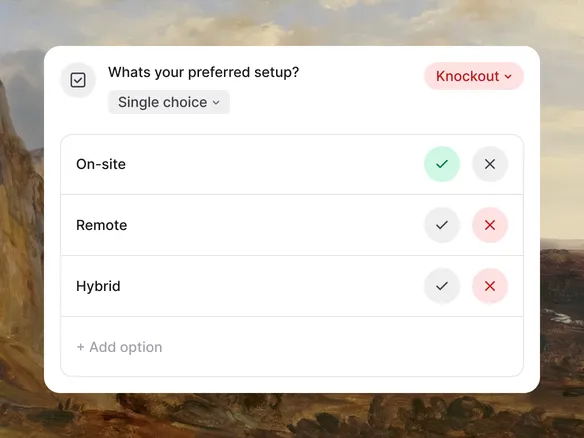
Hard requirements become questions on the application form
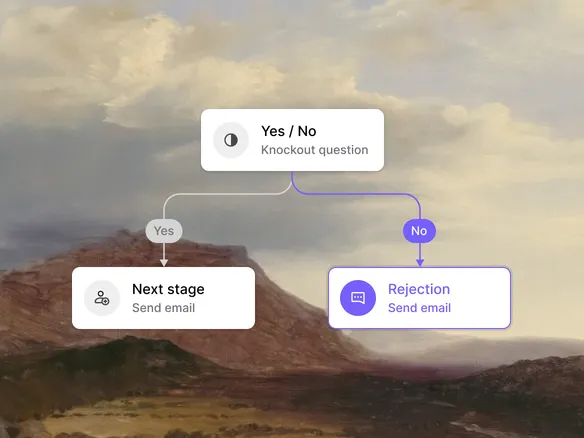
Candidates flagged in the pipeline — never silently rejected
Recruiter sees the answer and the rule that triggered it
02
Four question types, structured rules.
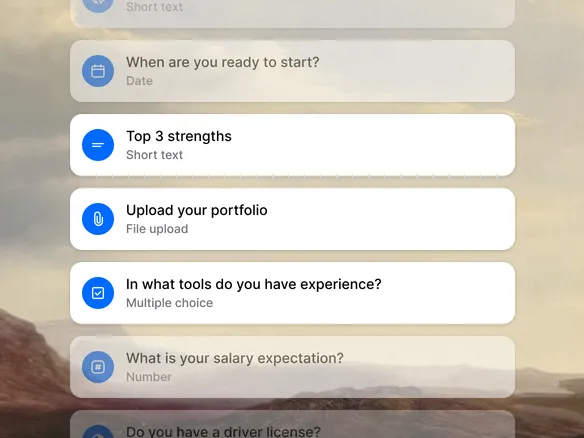
Single-select for yes/no (work permit, on-site). Multi-select for coverage ('which of these tools have you used?'). Numeric for thresholds (years of experience, salary expectation). Date for timing (earliest start, notice period). Each question carries a pass/fail rule, or stays as a soft signal you can review later.
Single-select for yes/no requirements like work permit or on-site
Numeric for thresholds like years of experience or salary
Date for timing like earliest start date or notice period
03
Flag, don't auto-reject. Audit, don't black-box.
Every knockout decision is logged with the candidate's answer and the rule that matched. No silent rejections, no candidate falling through a black box. Stage transitions (including rejection) still require a recruiter action, so screening surfaces signal rather than making decisions for you. Full compliance docs on trust.join.com.
Every knockout decision logged with the answer and rule
Stage transitions always require a recruiter action
Full compliance documentation on trust.join.com
WHAT YOU CAN DO
Filter the obvious mismatches before review.
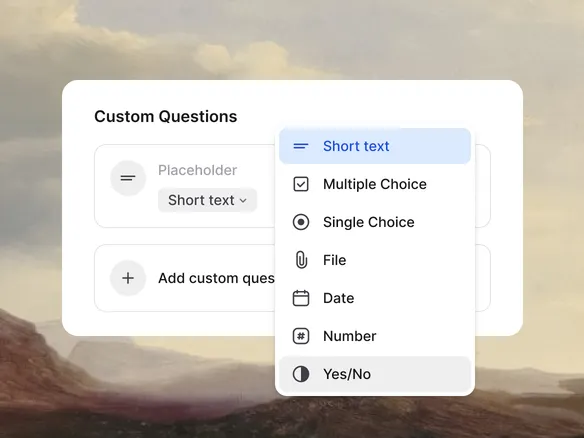
Four question types
Single-select, multi-select, numeric, and date. Pick the one that fits the requirement; rules follow the type.
Pass/fail or soft-flag
Set a hard pass/fail rule, or leave it as a soft signal for the recruiter to review. Per question, per role.
Per-role configuration
Knockouts attach to the job's application form, so each role asks its own questions. Templates make the common combinations reusable.
Auditable decisions
Each knockout outcome logs the answer the candidate gave and the rule that triggered. Compliance-ready, no manual record-keeping.
Application screening FAQ
What's a knockout question?
A question on the application form that gates the application against a hard requirement. If a candidate's answer fails the rule (no work permit, no driving licence, can't start on time), the application is flagged in the pipeline so the recruiter sees the mismatch before reviewing the CV.
What types of knockout questions does Join support?
Four types today: single-select (yes/no or pick one), multi-select (pick several), numeric (years of experience, salary expectation), and date (earliest start, notice period). Each type supports a pass/fail rule (hard knockout) or a soft-flag (review-only).
Does Join auto-reject candidates who fail a knockout?
No. Knockouts flag candidates, they don't reject them. Every stage transition (including rejection) still requires a recruiter action. The screening signal guides attention; the decision stays with the person.
Is there an audit trail for knockout decisions?
Yes. Every knockout outcome is logged on the candidate profile with the answer they gave and the rule that triggered. Compliance-ready: useful for GDPR audits and for the EU AI Act human-oversight requirement on candidate-decision systems.
Does Join offer AI-based candidate ranking?
Not yet. We ship AI when it's transparent. The roadmap is ICP-based ranking: the recruiter defines the ideal candidate profile (supported by AI), Join's AI parses each CV against that profile, and candidates get a chance to confirm or correct what was parsed so people aren't penalised for incomplete CVs. We'll announce when it ships; until then, screening focuses on the application-form knockouts, which are the explainable, auditable part.